

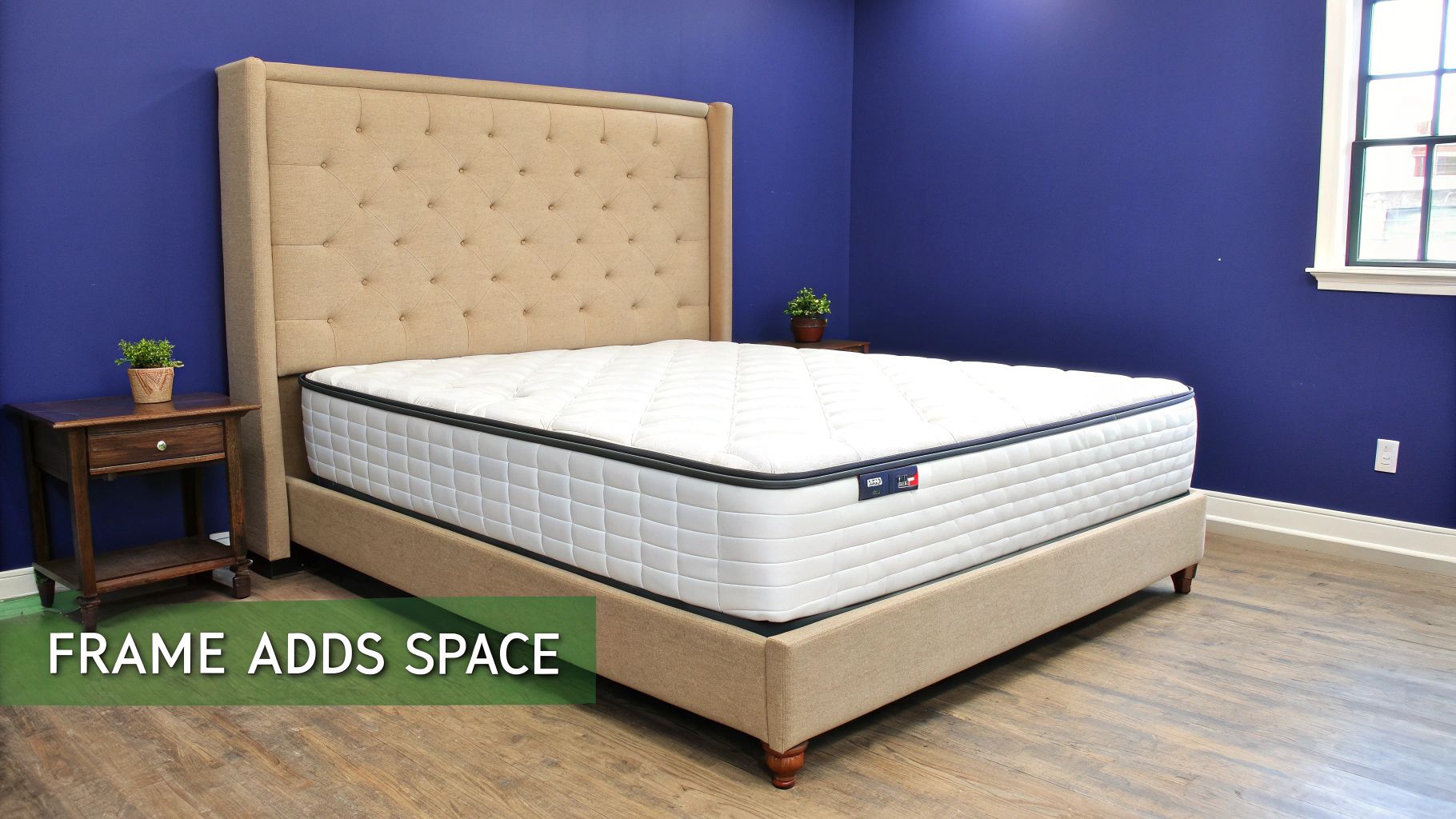
Dreaming of upgrading to a king size bed? You're not alone. Here in New Zealand, a standard king size bed measures 168cm wide by 203cm long. It’s a hugely popular choice for couples, offering that sweet spot of extra personal space without completely taking over the bedroom. That additional room can be the difference between a good night's sleep and a great one.
Your Quick Guide to NZ King Bed Dimensions
When you’re looking for a new bed, size is everything. Knowing the exact king size bed dimension is crucial for planning your bedroom layout, ensuring your new sanctuary fits perfectly and gives you the rest you deserve.
The standard New Zealand king is 168 cm wide and 203 cm long. While it shares the same length as a queen, it gifts you an extra 15 cm of width. Trust us, that extra space feels like pure luxury when you’re sharing the bed and want room to stretch out without playing bumper cars. For a deeper dive, you can find a comprehensive breakdown of all NZ bed sizes here.
This chart gives you a quick visual comparison of how the most common Kiwi bed sizes stack up.
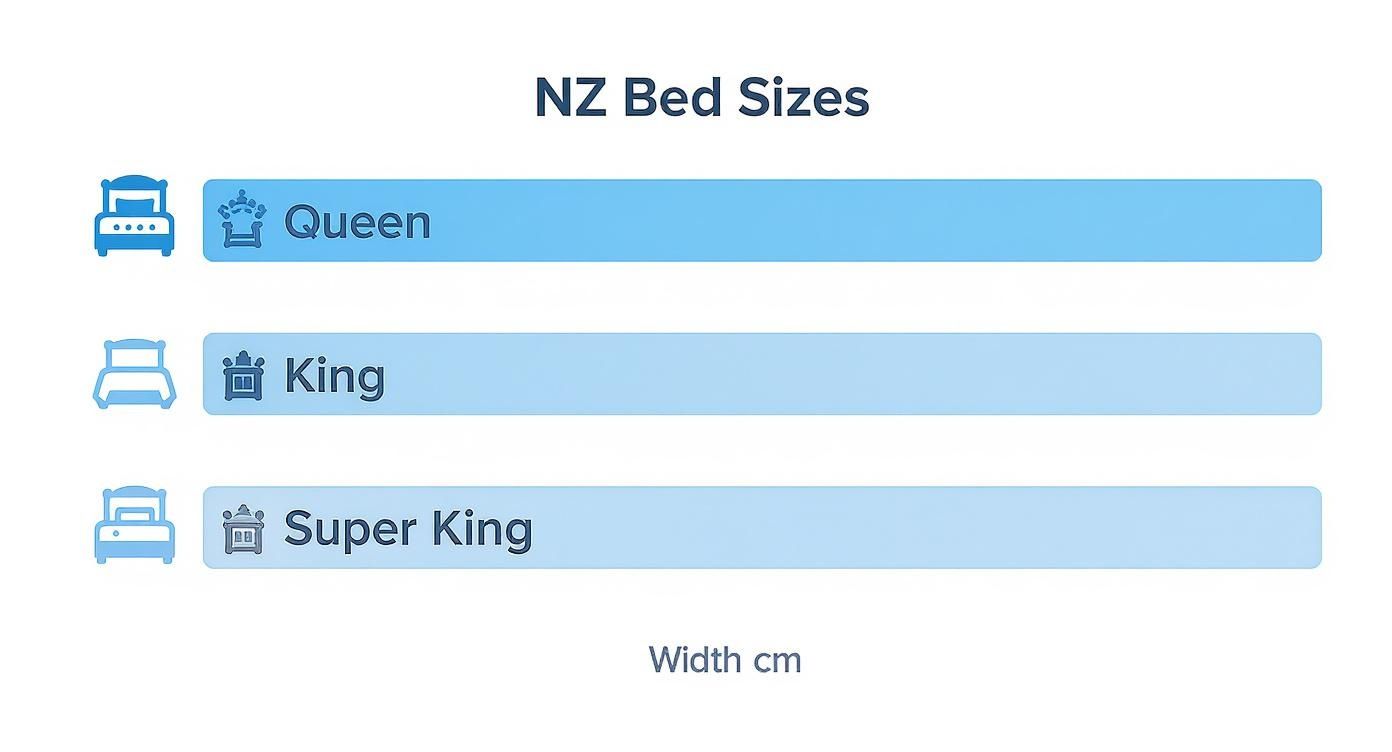
As you can see, the king offers that perfect middle ground—more spacious than a queen, but not quite as massive as a super king, making it ideal for most Kiwi master bedrooms.
Bed Size Comparison NZ vs International
Here's something that catches a lot of people out: assuming a "king" is the same size everywhere. It's not. The dimensions can vary wildly from country to country, which is a real headache if you're buying an imported bed frame or trying to fit overseas linen. For instance, what we call a Super King in NZ is what Australians call a standard King.
Here’s a quick reference table to help you see the differences at a glance.
Bed Size Comparison NZ vs International
| Bed Size | Width (cm) | Length (cm) | Region |
|---|---|---|---|
| NZ Queen | 153 | 203 | New Zealand |
| NZ King | 168 | 203 | New Zealand |
| NZ Super King | 183 | 203 | New Zealand |
| AU King | 183 | 203 | Australia |
| UK King | 150 | 200 | United Kingdom |
| US King | 193 | 203 | United States |
Keeping this table handy is a smart move, especially if you're shopping online or considering international brands. It can save you from a costly and frustrating mistake.
Understanding Your Bed's True Footprint
It’s easy to focus on mattress dimensions when choosing a new king bed. But here’s a pro tip people often miss: the mattress size is just your starting point. The real amount of floor space your bed will occupy—its true footprint—is always bigger once you factor in the frame and headboard.
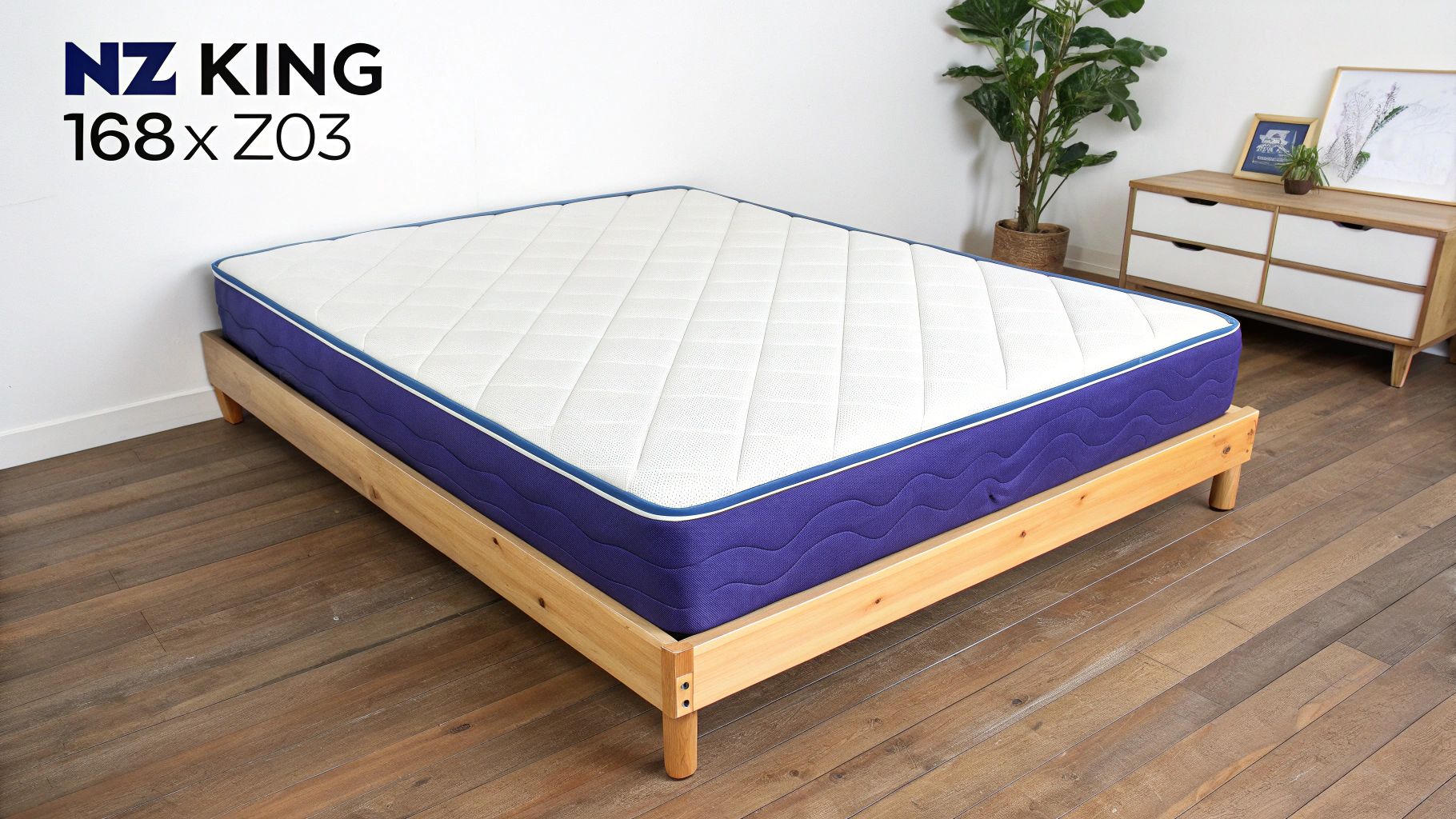
A common pitfall is assuming the bed base is the same size as the mattress. It can't be. To properly support the mattress, the frame itself has to be slightly wider and longer. With a simple, minimalist frame, this difference might only be a few centimetres, but with a more elaborate design, that extra space can really add up.
How Frames and Headboards Add to the Total Size
The style of your bed frame plays a huge role in its final dimensions. A slimline metal frame might only add a few centimetres to the overall width and length. On the other hand, something like a modern sleigh bed or a chunky, upholstered frame can easily add 10 to 20 cm to both the width and length.
It's the same story with headboards. A big, statement headboard will increase the bed's overall length and how far it projects from the wall. So, before you click 'buy', make sure you check the external dimensions of the entire bed ensemble, not just the mattress size it's designed for.
Here’s a practical example:
- A standard NZ King mattress is 168 cm wide.
- If you choose an upholstered frame with 5 cm of padding on each side, the total width suddenly becomes 178 cm.
- Add a thick, freestanding headboard, and you could add another 10 cm to the length, turning your 203 cm long bed into a 213 cm long feature piece.
Understanding the complete footprint is absolutely critical for smart room planning. By measuring for the entire bed assembly, you'll avoid that sinking feeling when you realise your beautiful new bed makes the room feel cramped or, worse, blocks a doorway.
For more advice, check out our detailed guide on choosing the perfect king bed frame to match your mattress and your space. Taking this extra step ensures your bed is a comfortable centrepiece, not an oversized obstacle.
Comparing Standard NZ Bed Sizes
Before you settle on a king, it's wise to see how it stacks up against the other standard sizes here in New Zealand. Getting your head around all the options can feel overwhelming, but it gets simpler when you think about who’s using the bed and what room it’s going into.
Each size is designed with a specific person or space in mind, from a child's first 'big bed' all the way up to a sprawling master suite. It's all about matching the bed's footprint to your room and your lifestyle.
A Breakdown of Common NZ Sizes
To give the king bed some real-world context, let’s run through the full lineup of standard sizes you’ll find across the country. This should help you visualise how much bigger each step up is.
- Single (91cm x 188cm): The go-to for children's bedrooms and smaller guest rooms. A compact classic that works perfectly for one.
- King Single (107cm x 203cm): A brilliant solution for growing teens or any taller person needing that extra legroom without taking up too much width.
- Double (137cm x 188cm): Once the standard for couples, these days the double is a popular choice for single adults who love more space to themselves. For a closer look, we have a complete guide on the double bed size here.
The Best Options for Couples
When you’re sharing a bed, personal space is golden. It's the width that makes the difference between a good night's sleep and a restless one, and this is where the larger sizes truly shine.
In New Zealand, the Queen and King are by far the most popular choices for couples. A Queen provides a comfortable amount of space for two, but a King offers a serious upgrade in personal sleeping room, often meaning less disturbance from your partner and a much better sleep.
- Queen (153cm x 203cm): Our most popular bed size, and for good reason. It’s a great fit for most Kiwi master bedrooms and gives two adults comfortable room.
- King (168cm x 203cm): This is where you get a noticeable upgrade. A king gives each person 84cm of width—a welcome increase from the 76.5cm each gets in a Queen.
- Super King (183cm x 203cm): The ultimate in space and comfort. If you have a large master bedroom, a Super King offers maximum room for couples, especially if kids or pets often join you.
As you weigh the pros and cons, seeing a direct comparison can be incredibly helpful. For a more detailed analysis, this ultimate guide to choosing between a king vs queen size bed is an excellent resource.
Planning Your Bedroom Layout for a King Bed
Bringing a king bed into your home is a fantastic upgrade, but its generous size demands a bit of forethought. Without proper planning, that dream of a spacious retreat can quickly turn into a cramped reality. It’s about more than just fitting the bed in the room; it’s about making sure the space still works for you.
Too often, people misjudge the sheer footprint of a king bed. It should be the centrepiece of a relaxing sanctuary, not a giant obstacle course you have to navigate every morning. Getting the layout right means you’ll have plenty of room to walk, open drawers, and even make the bed without a struggle.
Finding the Right Room Size
So, how much space do you actually need? For a king bed to feel right at home in New Zealand, a good rule of thumb for your bedroom is a minimum size of 3.5 metres by 4 metres. This isn't just about the bed itself, but about leaving enough breathing room around it.
That extra space is what separates a bedroom that feels airy and restful from one that just feels… full.
The Importance of Clearance Space
In any bedroom design, clearance is king. And when you have a king bed, it's absolutely non-negotiable.
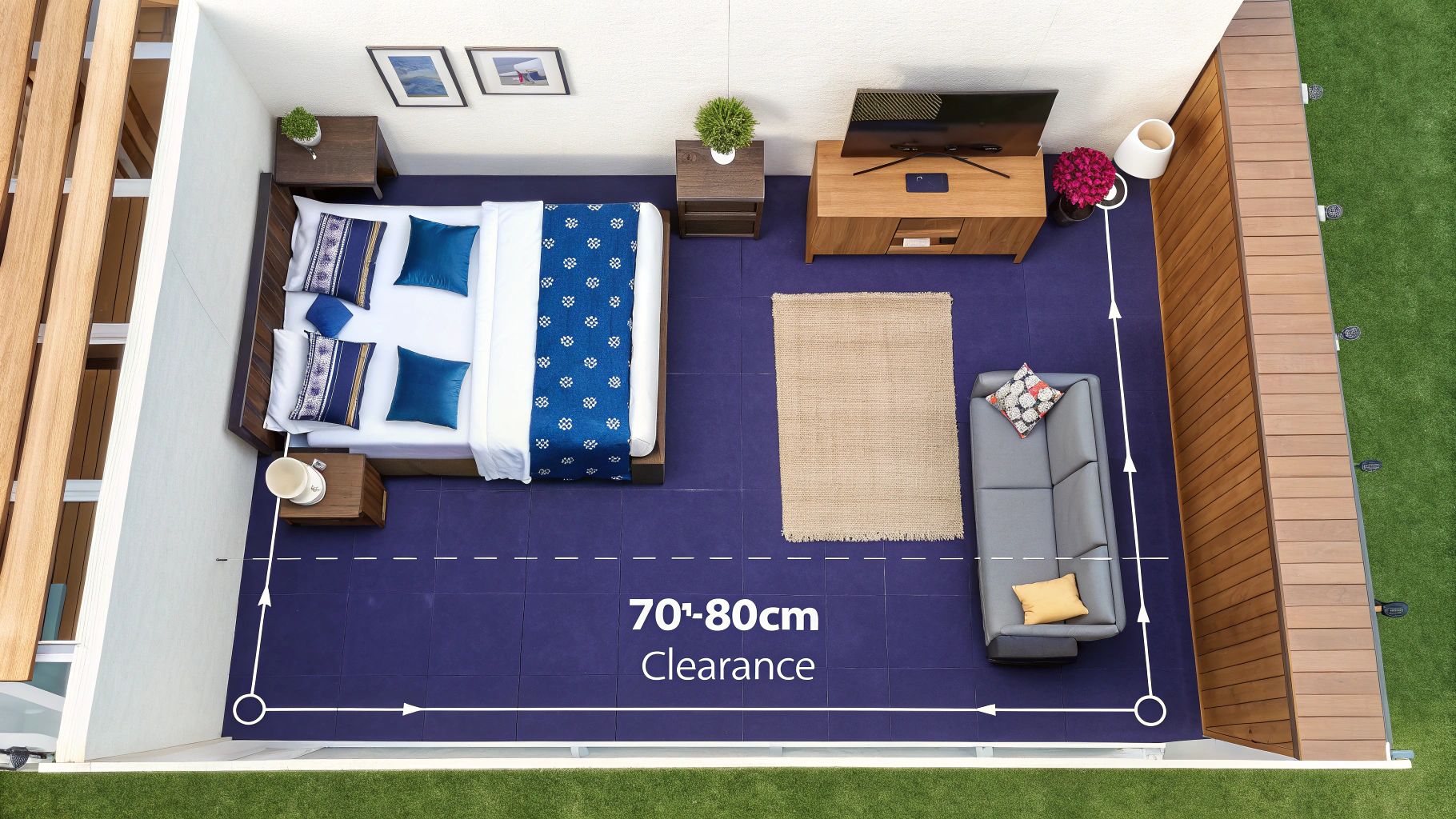
As a practical guideline, aim for at least 70cm to 80cm of clear walking space on two, preferably three, sides of the bed. This is the sweet spot for easy movement, letting you access wardrobes and dressers without bumping into the frame.
Here’s why that buffer zone is so important:
- Easy Movement: It gives you and your partner a clear path to get in and out of bed without climbing over each other.
- Furniture Access: You need to be able to swing wardrobe doors wide open and pull out drawers completely. Nothing is more frustrating than a drawer that only opens halfway.
- Making the Bed: Ever tried to tuck in a fitted sheet with your back against a wall? Enough space makes changing the linen a quick job, not a workout.
Before you commit, grab some masking tape and mark out the bed’s dimensions on your floor. This simple trick gives you a real-world feel for how much space the bed will take up and helps you visualise the flow of the room. For more tips on furnishing your space, check out our guide on choosing the best bedroom furniture in NZ to go with your new bed.
Choosing the Right Linen for Your NZ King Bed
Finding the perfect linen can turn your king size bed into a luxurious retreat, but only if it fits properly. Getting the sizing right from the start means you can skip the frustration of fitted sheets that constantly ping off the corners or a duvet that leaves you in a nightly tug-of-war.
The first thing to check is your mattress depth. Many modern pillow-top and hybrid mattresses are significantly deeper than older models. A standard fitted sheet just won't cut it. Before you shop, grab a tape measure and find out the exact height of your mattress to guarantee a snug, secure fit.
Recommended Linen Dimensions
To make your linen shopping a breeze, here’s a quick guide to the ideal measurements for a standard NZ king bed (168cm x 203cm).
Recommended Linen Sizes for an NZ King Bed
Finding linen labelled "King" is a good start, but checking the specific measurements on the packaging is always the best policy. Here are the dimensions you should be looking for.
| Linen Type | Recommended Width (cm) | Recommended Length (cm) | Notes |
|---|---|---|---|
| Fitted Sheet | 168 - 170 | 203 - 205 | Pocket depth is key. It must match your mattress height (e.g., a 40-50cm pocket). |
| Flat Sheet | 260 - 275 | 270 - 285 | This size gives you plenty of fabric to tuck in securely on all sides. |
| Duvet Cover | 245 - 250 | 210 - 215 | This is the standard NZ King size and will give your duvet a perfect, plush fit. |
| Mattress Protector | 168 - 170 | 203 - 205 | A good protector should fit just as snugly as your fitted sheet. |
Matching these dimensions ensures everything looks neat, feels comfortable, and stays put through the night.
Should You Upsize Your Duvet?
Here’s a popular styling tip: try using a Super King duvet (which is around 265cm x 210cm) on your King bed. Why? The extra width provides a generous overhang on the sides, creating that lush, hotel-style look. It’s also a brilliant solution for couples, putting an end to the nightly battle for the covers.
If you’re looking for a duvet that combines comfort with a sophisticated look, a classic design like the Canal Stripe Duvet Cover can really elevate the feel of your room.
And don’t forget that protecting your mattress is just as crucial as choosing beautiful sheets. If you decide to go with a larger duvet, you might want to look into a matching Super King mattress protector to keep things consistent and well-protected.
Your Essential Pre-Purchase Checklist
We've all heard the horror stories: a beautiful new king bed arrives, only to get stuck in the doorway. An exciting purchase can quickly turn into a logistical nightmare if you haven't done your homework.
Before you hit 'buy', grabbing a tape measure is the single most important thing you can do. This isn’t just about the final king size bed dimension in your bedroom; it’s about the entire journey from the delivery truck to its final resting place. A few minutes of prep now will save you a world of stress on delivery day.
Measure Your Home's Access Route
Think like a delivery person. What path does your new bed need to take to get to the bedroom? It's often an obstacle course of tight corners and narrow spaces you don't normally notice. Don’t just eyeball it—measure every single point along the way.
Here are the critical checkpoints to measure:
- Doorways: Get the exact height and width of every doorway on the path. Remember to account for chunky door handles that might reduce your clearance.
- Hallways and Corridors: Check the width of your hallways. Pay close attention to any tight turns, because a long bed base needs room to pivot.
- Stairwells: Stairs are almost always the biggest challenge. Measure the width, but also check the ceiling height at the top and bottom landings, especially at any turns. It's easy to get a bed frame jammed here.
- Obstacles: Keep an eye out for any low-hanging light fixtures, radiators, or built-in shelving that could get in the way.
A quick tip from experience: the bed base is usually the most rigid and awkward piece to manoeuvre. While a mattress can often be flexed a little, a solid bed frame has absolutely no give.
Once you’ve confirmed the bed can actually get into your house, you're ready for the fun part. To help you make that final decision, our guide on how to choose the perfect mattress in New Zealand is a great resource. Following this simple checklist means you can shop with total confidence.
Answering Your King Bed Questions
When you're investing in a new bed, a few questions always pop up. To help you feel confident in your choice, we've put together some straight-to-the-point answers to the most common queries we hear about king size beds in New Zealand.
Getting these details sorted now means you’ll end up with a bed that’s a perfect match for your home and your lifestyle.
Key Size and Bedding Questions
One of the biggest trip-ups for Kiwi shoppers is getting caught out by international sizing. It’s easy to think a ‘king’ is a king everywhere, but dimensions vary quite a bit from country to country. Another hot topic is bedding – specifically, how to get that plush, hotel-like feel.
-
Is a NZ King the same as an Australian King?
No, and this is a really important one to remember. A New Zealand King is 168cm x 203cm. An Australian King is significantly wider at 183cm x 203cm. If you're buying a bed frame or linen from an Aussie retailer, always double-check the measurements to avoid a poor fit. -
Can I use Super King bedding on my King bed?
Absolutely! In fact, many people do this on purpose. Using a Super King duvet on a King bed gives you much better coverage and a more luxurious, drapey look. It’s also a fantastic trick if you’re constantly fighting for the covers. Just remember, you’ll still need standard King size fitted sheets to fit your mattress snugly.
Space and Popularity in New Zealand
It helps to know how a king bed actually fits into a typical Kiwi home and why they've become so popular. The move towards bigger beds says a lot about how our lifestyles are changing.
Recent figures show a definite trend towards more generous sleeping spaces. Roughly 40% of mattress sales in the premium market are for king size beds, and that number is climbing. This is often tied to families sharing the bed with kids or pets, or simply that master bedrooms in new builds are getting bigger. You can read more about these NZ mattress trends on wisemove.co.nz.
The main takeaway is that while a king bed takes up a decent amount of floor space, the comfort and lifestyle benefits are making it the go-to choice for more and more New Zealanders.
Finally, let's tackle the most practical question of them all.
-
What is the minimum room size for a king bed?
Every room has its own quirks, but a good rule of thumb is a minimum size of 3.5m x 4m. This leaves enough room for the bed itself plus about 70-80cm of walking space around three sides. That space is crucial – not just for moving around, but for making the bed without a daily struggle.
Ready to find the perfect bed for your space? At New Zealand Bed Company, we have a wide range of king beds and mattresses to suit every home and budget. Browse our collection today and start your journey to a better night's sleep.