

The hunt for a better night's sleep is something we all share, and for plenty of Kiwis, the answer is a memory foam mattress. This isn't just any old foam; it's a clever material that moulds to your body's unique shape, delivering a sleep experience that feels like it was made just for you.
Your Guide to Finding the Perfect Sleep in New Zealand
Stepping into the world of mattresses can feel a bit overwhelming, with all the different terms and marketing spin. This guide is here to cut through that noise. We'll give you a straightforward, practical look at why memory foam has taken off across Aotearoa and how to find the right one for you.
Think of it less as just a mattress and more as a complete sleep system. It’s designed to hug your curves and support you exactly where you need it, helping you wake up feeling genuinely rested and ready for the day.
And it's not just hype. Memory foam mattresses have become a top pick for a reason. Consumer surveys back this up, showing a massive 81% of customers were satisfied with their purchase. That puts memory foam right at the front of the pack, ahead of traditional innersprings, latex, and even hybrid models in our diverse local market.
What You Will Learn in This Guide
Over the next few sections, we'll walk you through everything you need to know to make a smart, confident decision. Our goal is to give you the tools to invest in better rest, which, as we all know, is crucial for our overall health and wellbeing. By enhancing sleep quality in New Zealand, you can boost everything from your energy during the day to your long-term health.
Here’s a sneak peek at what we'll cover:
- The Science of Comfort: We’ll break down what memory foam actually is and how its unique properties work to cradle your body.
- Choosing Your Ideal Match: Learn how to pick the right firmness and features based on your sleeping style and personal needs.
- Navigating the NZ Market: Get the lowdown on New Zealand bed sizes, what to expect with pricing, warranties, and how to look after your new mattress.
Your mattress is so much more than a piece of furniture—it’s a direct investment in your health. Making the right choice means that investment will pay off with years of restful nights and energised days.
What Makes Memory Foam Different?
Believe it or not, the story of your memory foam mattress starts in space. Back in the 1960s, NASA was looking for a way to make astronaut seats safer and more comfortable during the extreme forces of lift-off. The material they developed eventually made its way from the launchpad right into our bedrooms, completely changing how we think about a good night's sleep.
The magic behind it all is a property called viscoelasticity. It sounds a bit technical, but it’s actually quite straightforward. The "visco" part means it moves slowly under pressure, a bit like thick honey. The "elastic" part means it bounces back to its original shape once that pressure is gone.
Imagine pressing your hand into a block of the foam. It doesn't just squish down; it slowly yields, creating a perfect cradle for your hand. When you lift it away, you'll see a clear impression that gradually fades as the foam returns to its flat state. That's viscoelasticity in action.
This unique contouring ability is precisely what provides that signature pressure-relieving comfort everyone talks about.
The Science of Comfort
So, how does this work when you're actually sleeping on it? Your own body provides the magic ingredients: heat and weight. As you lie down, the warmth from your body softens the foam, allowing it to mould perfectly to your unique shape. It’s like getting a custom-fit sleep surface every single night.
This incredible adaptability is what delivers the three key benefits memory foam is famous for:
- Superior Pressure Relief: By spreading your body weight evenly across the surface, the foam takes the load off your main pressure points—think hips, shoulders, and knees. This means less tossing and turning and more deep, restorative sleep.
- Proper Spinal Alignment: The foam fills in the gaps and supports the natural S-curve of your spine, helping you maintain a healthy, neutral posture all night long. This is a huge factor in preventing and even easing back pain.
- Incredible Motion Isolation: Have you ever been woken up by your partner moving? Memory foam absorbs that movement right where it happens, so it doesn't ripple across to your side of the bed.
For anyone who shares a bed, especially light sleepers, motion isolation is an absolute game-changer. Your partner getting up for a glass of water no longer has to mean your own sleep is disturbed.
From Space Tech to Your Bedroom
It took a while for this technology to become practical for home use, but as manufacturing evolved, memory foam became more accessible. The foam we sleep on today is a world away from the original NASA formula. Modern foams have been engineered to be more breathable, more durable, and are available in a huge range of firmness levels to suit just about everyone.
When you bring a memory foam mattress into your New Zealand home, you're not just buying a bed. You're investing in decades of material science, all honed for one simple goal: giving you a deeper, more comfortable sleep by adapting perfectly to you. This ability to contour, support, and isolate movement is what truly sets it apart from any traditional spring or latex mattress.
How to Choose Your Ideal Memory Foam Mattress
Choosing the right memory foam mattress can feel like a huge decision, but it really doesn't need to be overwhelming. If you know what to look for, you can cut through the noise and find the perfect fit for your sleep needs.
This section will walk you through the most important things to consider when you're looking for a memory foam mattress in New Zealand. We’ll cover the three big ones: firmness, heat regulation, and what’s actually inside the mattress. Get these right, and you're on your way to years of brilliant sleep.
Matching Firmness to Your Sleep Style
First things first, let’s talk about firmness. This is probably the most critical choice you’ll make. It’s not just about what feels comfy when you first lie down; it’s about giving your body the right kind of support all night long.
Your ideal firmness almost always comes down to how you sleep—on your side, back, or stomach—and to a lesser degree, your body weight.
-
Side Sleepers: If you’re a side sleeper, you need a mattress that can give way a little under your shoulders and hips. A soft to medium firmness is usually best, as it lets these pressure points sink in just enough to keep your spine straight. Too firm, and you’ll wake up with a sore shoulder.
-
Back Sleepers: For back sleepers, the name of the game is supporting the natural curve of your spine. A medium to medium-firm mattress hits the sweet spot. It's soft enough to cushion your lower back while still being firm enough to stop your hips from sinking too far down.
-
Stomach Sleepers: This position puts the most pressure on your spine, so you need a mattress that can fight back. A medium-firm to firm feel is essential to keep your hips and tummy from dipping, which is the main cause of lower back pain for stomach sleepers.
Your body weight plays a part, too. People under 60kg often prefer a softer feel, while those over 100kg generally need a firmer mattress to get the proper support without sinking in too much.
To make it even simpler, here's a quick guide to help you find your starting point.
Memory Foam Firmness Guide by Sleeper Type
| Sleeper Profile | Recommended Firmness | Why It Works |
|---|---|---|
| Side Sleepers & Lighter Individuals | Soft to Medium | Cushions the shoulders and hips, allowing the spine to stay in a straight, neutral line. |
| Back Sleepers & Combination Sleepers | Medium to Medium-Firm | Balances soft contouring for the lower back with robust support to prevent hip sinkage. |
| Stomach Sleepers & Heavier Individuals | Medium-Firm to Firm | Provides maximum support to keep the abdomen and hips elevated, preventing spinal strain. |
Remember, this is a guide, not a rulebook. Your personal comfort is what matters most, but this should give you a great idea of where to begin your search.
The right firmness isn’t just about comfort—it’s about health. Proper spinal alignment during sleep can reduce aches and pains, improve posture, and lead to more energising mornings.
Staying Cool in New Zealand’s Climate
One of the old stereotypes about memory foam is that it sleeps hot. While that might have been true for the early versions, modern mattress technology has completely solved this problem. Here in New Zealand, with our humid summers and chilly winters, having a mattress that can regulate temperature is a must.
So, how did they fix it? The original memory foam had a "closed-cell" structure, which basically trapped air and body heat. Today’s advanced foams are a world away from that.
Modern Cooling Solutions:
- Open-Cell Foam: Think of this like a sponge. The foam is engineered with tiny, interconnected pockets that allow air to flow freely right through the mattress, wicking away heat and moisture.
- Gel-Infused Foam: This is a game-changer. Tiny gel beads or swirls are mixed into the foam. Gel is a natural conductor of heat, so it actively pulls warmth away from your body and disperses it, keeping the sleeping surface cool and comfortable.
These innovations are a big reason why memory foam is becoming so popular. In fact, the market in our region is booming, projected to grow at 12.5% annually from 2025 to 2033. Kiwis are more focused on their sleep health than ever, and these new technologies are delivering real solutions.
Understanding Mattress Density and Layers
Finally, let's peel back the cover and see what’s inside. A memory foam mattress isn't one big slab of foam. It’s a sophisticated system of different layers, each with a specific job. The two main players are the comfort layer and the support core.
The bit you feel first is the comfort layer. This top layer is usually a softer, lower-density memory foam that gives you that classic "hugging" sensation and relieves pressure points.
Underneath that is the support core. This is the workhorse of the mattress, made from a much firmer, high-density polyfoam. It provides the deep-down support, stops you from sinking in too far, and gives the mattress its durability and shape for years to come. To dive deeper into this, have a look at our full guide on how to choose the perfect mattress in New Zealand.
Generally, a thicker mattress has more substantial layers, which often means it will be more durable and offer deeper, more luxurious comfort. It helps to remember you're not just buying a mattress, but a complete sleep system.
This image sums up how all these benefits—pressure relief, spinal alignment, and not feeling your partner move—work together for a better night’s sleep.
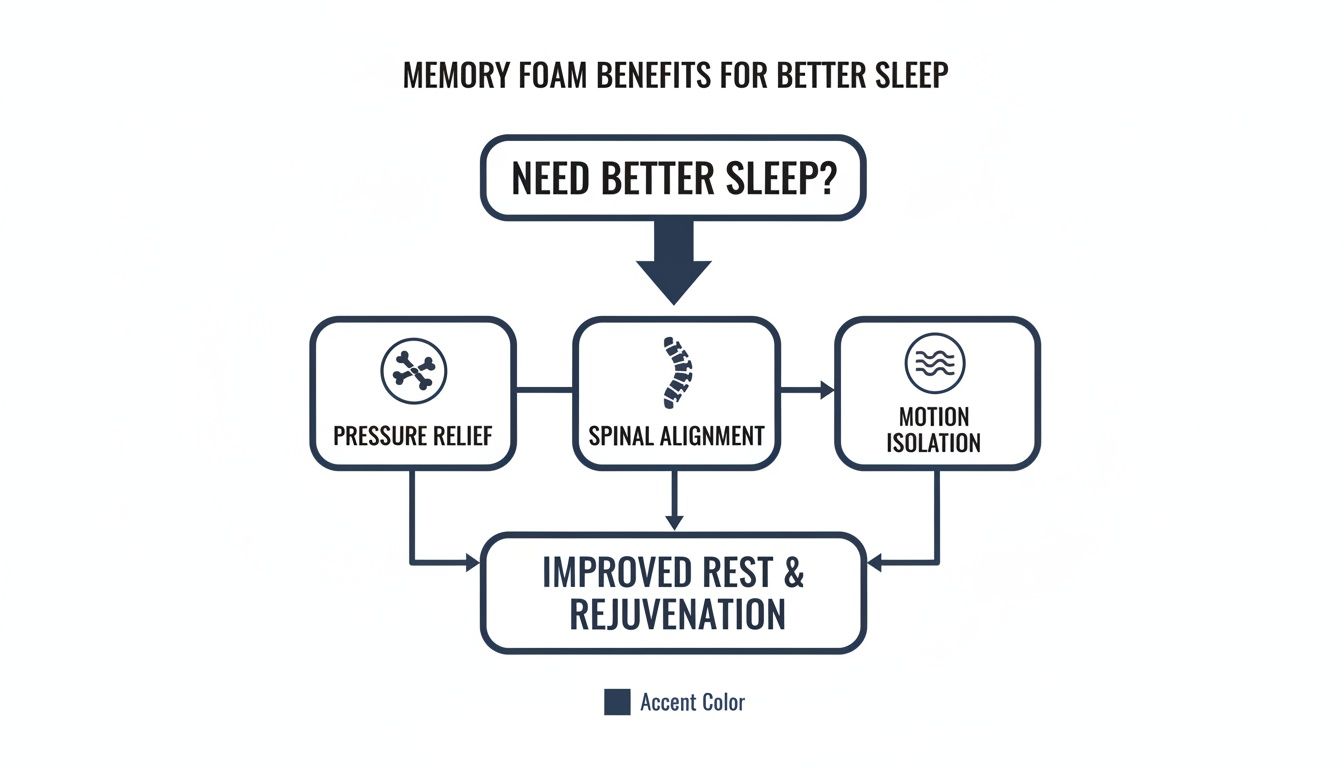
It’s a great visual for understanding how memory foam directly tackles common sleep issues, making your decision that much easier.
Size Matters: Getting the Right Fit for Your New Zealand Bed
It's easy to get carried away thinking about the cloud-like comfort of a new memory foam mattress. But before you get too lost in the dream, there's a practical step you can't skip: getting the size right. It's one of the most common pitfalls for Kiwi shoppers—assuming that a 'King' here is the same as a 'King' everywhere else.
Trust me, you don't want the hassle of a mattress that overhangs your base or leaves an awkward gap. So, before you click "buy", let's grab a tape measure and talk about standard New Zealand bed sizes. It’s the first step to making sure your new mattress fits your frame, your room, and your life perfectly.
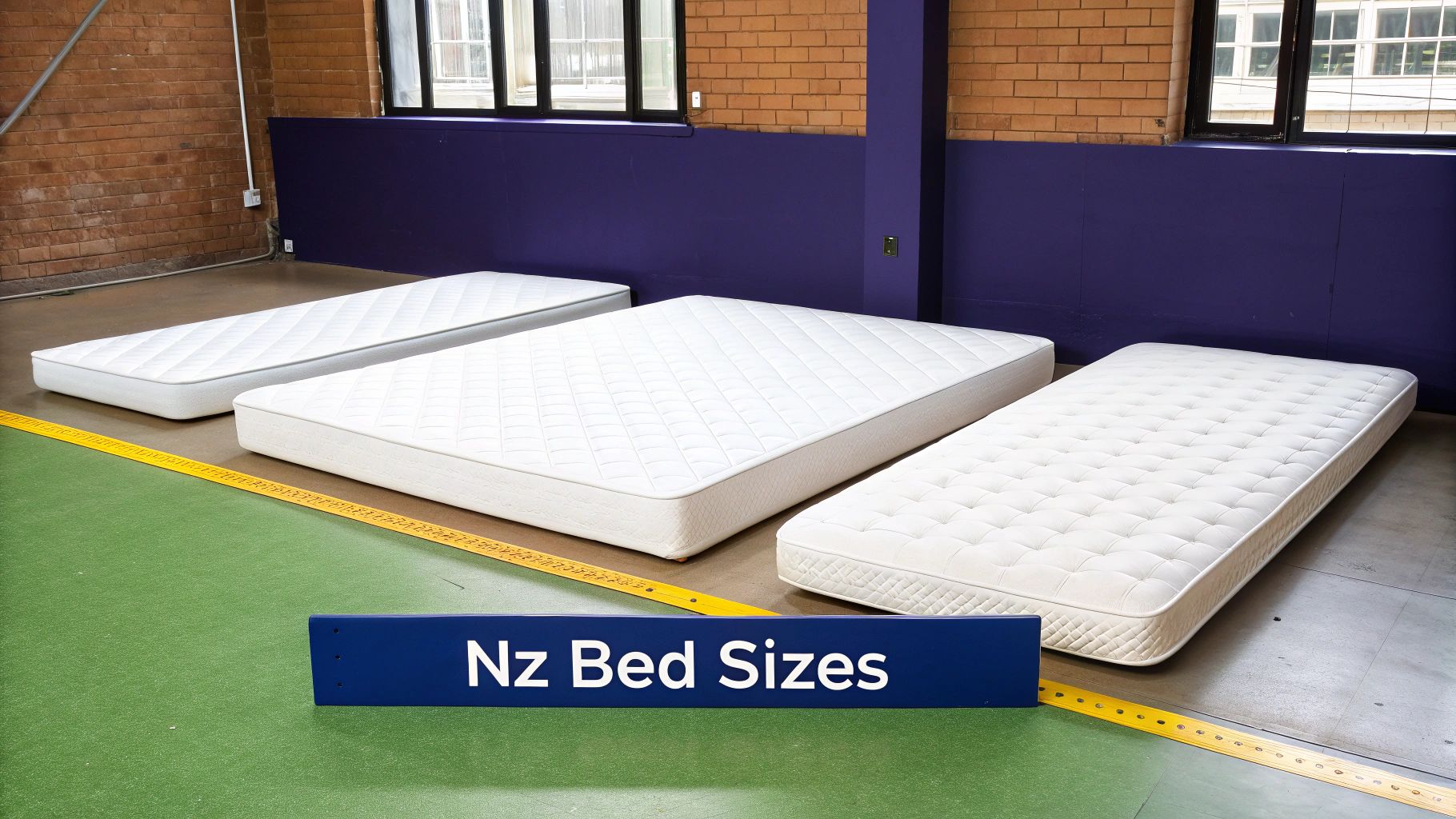
Standard NZ Mattress Dimensions
Unlike clothing, bed sizes aren't universal. New Zealand has its own specific dimensions that often differ from what you might find in Australia, the US, or the UK. Knowing the exact local measurements in centimetres is the only surefire way to avoid any surprises.
Here’s a quick rundown of the standard sizes you’ll encounter here in NZ:
- Single: 91cm x 188cm
- King Single: 107cm x 203cm
- Double: 137cm x 188cm
- Queen: 153cm x 203cm
- King: 167cm x 203cm
- Super King: 183cm x 203cm
- California King: 203cm x 203cm
A pro tip: always measure the internal dimensions of your bed frame, where the mattress will actually sit. Don't just measure the outside edges. For a deeper dive into the most popular sizes, check out our guide on what size a Queen mattress is.
Planning Your Bedroom Space
Once you know the mattress dimensions, it's time to think about your room's layout. A bed is usually the biggest piece of furniture in the room, and you need to be able to move around it comfortably.
As a general rule, try to leave at least 60-70cm of clear space around the sides and foot of the bed. This gives you enough room to walk, open wardrobe doors, and pull out drawers without feeling like you're in a Tetris puzzle. If you're looking for inspiration, exploring a few room layout ideas can help you picture how your new bed will anchor the space.
A new mattress can change the entire dynamic of a room. Planning the layout before you buy ensures your new sleep sanctuary is both comfortable and practical.
Peace of Mind with Quality Certifications
Getting the size right is about physical comfort, but knowing what's inside your mattress is about peace of mind. When you're shopping for a memory foam mattress in New Zealand, keep an eye out for foams that are CertiPUR-US® certified.
This certification isn't just marketing fluff. It's an independent guarantee that the foam has been rigorously tested for performance, durability, and, most importantly, its contents.
A CertiPUR-US® seal means the foam is made without:
- Ozone depleters
- Nasty flame retardants like PBDEs
- Mercury, lead, or other heavy metals
- Formaldehyde
- Regulated phthalates
Seeing that logo gives you confidence that you’re bringing a safer, healthier product into your home. It’s a key marker of quality that ensures your new bed delivers not just a great night's sleep, but a healthy one, too.
Navigating Price, Warranties, and Returns in NZ
Buying a new mattress is a real investment in your health, so getting your head around the financial side of things is just as important as picking the right feel and firmness. When you start looking at memory foam mattresses in New Zealand, you'll notice the prices can be all over the place. This usually comes down to things like the quality of the foam, any fancy cooling layers, and the brand's reputation.
The mattress market here in NZ is humming along. In fact, it's expected to bring in around USD 80.77 million in 2025, which just goes to show how many Kiwis are on the hunt for a better night's sleep. More choice is great for us, but it also means you need to be savvy about what you’re paying for and what happens if something goes wrong.
Your Consumer Safety Nets: Warranties and Sleep Trials
Once you look past the price, the two most critical things to check are the warranty and the return policy. Think of these as your safety nets. They give you peace of mind that your money is well-spent and that you’ve truly found the perfect match for your body.
A decent warranty is an absolute must-have. You'll want to see a warranty of at least 10 years, which is pretty standard for a quality mattress these days. A long warranty tells you the manufacturer stands by their product and expects it to last.
A great warranty is more than just a piece of paper; it’s a long-term promise of quality and support. It protects you from manufacturing defects like significant sagging or foam deterioration that shouldn't happen with normal use.
When you're reading the fine print, look for the words "prorated" or "non-prorated." A non-prorated warranty is what you really want. It means if the mattress is faulty, the company will repair or replace it without you having to fork out money based on how long you've had it. For a bit more context on this, you might find it helpful in understanding general warranty coverage.
The Importance of a Sleep Trial
Let’s be honest, lying on a mattress for five minutes in a bright showroom is nothing like sleeping on it for eight hours at home. Your body needs time to get used to a new surface, and that’s why an in-home sleep trial is the best way to buy with confidence.
Most good Kiwi companies will offer a trial period, usually somewhere between 30 and 120 nights. This gives you a proper chance to see if the mattress delivers the goods—great comfort, proper support, and a sound sleep, night after night.
Before you pull the trigger, make sure you're clear on the return process. It's always a good idea to ask:
- Is the return completely free? Some brands might sting you with a collection or restocking fee.
- How do I start a return? Know exactly who to call and what the steps are.
- What happens to returned mattresses? It's nice to know if they're donated to charity, which is a great sustainable option.
Here at New Zealand Bed Company, we keep things simple and clear. If you ever run into an issue, our team is here to help. You can easily find the details on how to claim your warranty on our website.
Financial Assistance Options for Kiwis
We firmly believe that everyone in New Zealand deserves a restorative night's sleep, no matter their budget. If you need a bit of help, there are options that can make a quality mattress much more affordable.
Work and Income (WINZ) can sometimes provide financial support for essential items like a new bed. This might be through a "Benefit Advance" or a "Special Needs Grant." If you think you might be eligible, you'll need to get an official quote from a registered supplier to include with your application. Many local retailers, including us, are very familiar with this process and can sort you out with the right paperwork to make it happen.
Caring for Your New Memory Foam Mattress
So, you’ve made a brilliant investment in your sleep! Now, let’s make sure that investment pays off for years to come. Looking after a new memory foam mattress is actually pretty straightforward, but a few simple habits will keep it feeling comfortable and supportive for the long haul.
The "New Mattress" Smell
When you first unbox your mattress, you might notice a slight, harmless scent. This is totally normal and is known as off-gassing – it’s just the release of compounds that were trapped in the airtight packaging. Think of it like a new car smell.
To get rid of it, just let the mattress air out in a well-ventilated room for a day or two before you make the bed. Crack a window, and that smell will be gone before you know it.
Protect Your Investment
Once it’s aired out, the single most important thing you can do is pop on a quality waterproof mattress protector. This is your first and best line of defence against everyday life.
A good protector shields your mattress from all sorts of things:
- Accidental Spills: Liquids are the enemy of memory foam and can easily void your warranty.
- Dust Mites and Allergens: It creates a hygienic barrier, keeping the inside of your mattress fresh.
- Body Oils and Sweat: It stops moisture from getting into the foam layers and causing them to degrade over time.
Keeping the mattress clean and dry is crucial. If you do have a mishap, always check the manufacturer's care instructions first. For more detailed tips, have a look at our guide on cleaning a mattress safely and effectively.
Rotation and a Solid Foundation
We often get asked if you need to flip a memory foam mattress. The answer is a definite no. Unlike old-school innerspring mattresses, memory foam beds are designed with layers in a specific order. You should never flip them over, as you’ll end up sleeping on the hard support base instead of the comfy foam.
You should, however, rotate it.
To keep your mattress wearing evenly, we recommend rotating it 180 degrees (from head to toe) every 3 to 6 months. This simple twist prevents body impressions from forming and keeps the entire surface feeling consistent and supportive.
Finally, what your mattress sits on really matters. A memory foam mattress needs a solid, flat foundation to perform at its best. We recommend either a solid platform base or a slatted base where the slats are no more than 7cm apart. This prevents sagging and ensures your memory foam mattress in New Zealand gives you a great night’s sleep for its entire lifespan.
Got Questions? We’ve Got Answers
Even after digging into all the details, you might still have a few questions rattling around. That’s perfectly normal. Most Kiwis do! Think of this as the final chat over the fence, where we clear up those last few lingering queries before you commit to years of incredible sleep.
Let's tackle the big ones.
"Is Memory Foam Toxic?"
This is a big one, and a really important question to ask. The short answer is no, a high-quality, certified memory foam mattress is completely safe. The worry usually comes from something called Volatile Organic Compounds (VOCs), which are gases that can be released from a new foam product.
This is what’s behind that "new mattress smell," a process known as off-gassing. While it sounds a bit concerning, any reputable brand in New Zealand will use foams that meet strict safety certifications like CertiPUR-US®. This certification is your guarantee that the foam has incredibly low VOC emissions and is made without nasty chemicals like formaldehyde, heavy metals, or certain flame retardants.
The easiest way to get peace of mind is to simply choose a certified memory foam mattress in New Zealand. That new smell from a certified mattress isn't harmful and typically fades within a few days, especially if you air out the room.
"How Long Will It Actually Last?"
A well-made memory foam mattress is a solid investment in your sleep. You can realistically expect to get 7 to 10 years of fantastic comfort and support out of it, putting it right up there with other top-tier mattress types.
Of course, a few things will influence its lifespan:
- The Density of the Foam: Denser foams are simply tougher and better at resisting sagging over time.
- A Solid Foundation: Make sure it’s on a proper base, either solid or with slats spaced correctly. This prevents it from wearing out unevenly.
- Give it a Spin: Rotating your mattress 180 degrees every six months or so really helps spread the wear.
"Will I Overheat on a Memory Foam Mattress?"
Ah, the classic heat question. It's true that the memory foam of yesteryear had a bad rap for trapping heat. But technology has come a long way since then, and modern foams are a completely different story.
Today's advanced mattresses are specifically engineered to keep you cool. You'll see features like:
- Gel-Infused Foam: Tiny gel beads are swirled into the foam, and their job is to pull heat away from your body.
- Open-Cell Structure: Think of it like a microscopic sponge. This design allows air to flow freely through the mattress, letting heat and moisture escape.
These clever innovations mean your bed stays a cool, comfortable retreat, even in the peak of a Kiwi summer.
"What Do I Do With My Old Mattress? Can It Be Recycled?"
Trying to dispose of an old mattress responsibly is on a lot of our minds. While memory foam itself isn't biodegradable, making recycling a bit complex, there are definitely some great eco-friendly options here in New Zealand.
Services like Andoo (who partner with All Heart NZ) and EcoDrop in Christchurch have fantastic programmes for recycling or repurposing old mattresses. They break them down and salvage the components, keeping a massive amount of waste out of our landfills. It’s always worth checking with your local council or the retailer you're buying from to see what the best options are in your neck of the woods.
Ready to feel that unique, body-hugging comfort for yourself? The expert team at New Zealand Bed Company is here to guide you to the perfect sleep solution. Come and explore our full range of high-quality, certified mattresses online today. Find your perfect mattress at nzbeds.co.nz